
An Droch-shúil: The Evil Eye
Note: as with many of my writings, I’ll be incorporating words and phrases as Gaeilge [in Irish] into this piece to examine cultural Irish writings and superstitions. Please keep in mind that I am a beginner with the Irish language, and I continue to learn and tap online, literary, and community resources to help further my understanding of correct usage. Tá cúpla focal agam - but this should stop no one from exploring the language. Please be kind!
An Drochshúil (also written “droch shúil” with a space or a hyphen): The Evil Eye. Never an affliction a seasoned practitioner wants to admit they suspect. But I have learned - and have been reminded - that the Eye can crop up for both the best of us, and the worst of us. The unfortunate reality is that none are safe, unless one simply suspects that everyone, at some point, may be charm-setting - whether they know it or not.
The Eye is easy to throw, and in the lives and times of our ancestors it was a common concern - especially for children and livestock. According to the wonderful transcripts we have from the National Folklore School Collection in Ireland, many local children would record folk magics and approaches that their parents and grandparents both passed down and lived to avoid and cure an droch-shúil - literally, “the bad eye”. It could be thrown by neighbors, passing folk - those jealous of your plenty, your crops. Crops and livestock were currency in rural regions, but I am sure city-folk feared for their health and habitations just as much as those in the country. Many writings we do have discuss stories of folk passing by cows and throwing the Eye out of jealousy, wishing they had a cow or horse as beautiful or as plump. This often would lead the animal to fall ill, in which a cure needed to be prepared. Often, an affliction by the Eye was referred to as being “overlooked,” and was not intended to be totally malicious in many cases. But some would disagree.
Anyone that has grown up within Irish or Irish diasporic culture will likely be somewhat familiar with the cursing and blessing traditions of our people. But for the very many that have not - where traditions were lost to assimilation or to religious authoritarian shaming - I would recommend this as an extremely interesting area of study. There is no shame in setting boundaries when necessary, and sometimes, a boundary is a curse. I do, however, hold to this: what is not a boundary or a protection is a curse that is thrown or set out of pettiness. If you are trying to lay someone low who never wronged you because you feel threatened by their success, that is unacceptable and deserving of ill-luck in return.
Little stopped our ancient and even pre-modern ancestors from protecting themselves, both with and against curses. Curse-tablets have been unearthed by archeologists across the Celtic-speaking world. Reminding us that the Celtic-speaking world stretches far beyond Ireland, Brigid Ehrmantraut discusses these curse tablets as ways to recover stolen property or avenge oneself in Pagan times. E. Moore Quinn, in the same vein, begins a discussion of cursing and blessing with the Gaeilge word guíodóireacht - which she asserts to mean both cursing and praying. Foclóir, the New English-Irish dictionary, defines the word as “wishing.” Wishing could certainly go either way - wishing one good or ill, for example, sounds a lot like it could evolve to be a blessing or a curse. Here’s to those who wish you well, and those that don’t can go to Hell.
Certainly, an droch-shúil falls into the latter category. In the Irish diasporic tradition, specifically within the North East, Quinn notes an interesting evolution of an ill-wish: “Bad cess (luck) to ye” is a phrase that survives within our collective memory, the origin of which Quinn asserts may connect to specific crops of corn or could be linked to the word ‘success’ in the old country. Rosarie Kingston examines an droch-shúil from an Indigenous Irish perspective: that illnesses on the island were caused by the Fairy Folk, the sí, the Evil Eye being one of those illnesses.
Marion McGarry discusses work of ill intent as ‘piseogs’ - a word that is remembered in the diaspora as well, defined by some as ‘superstition’ [piseog]. McGarry, however, writes that “the word ‘piseog’ not only relates to superstitious belief…it also refers to spells deliberately enacted with evil intent” - which she says suggests a more sinister side of folk magical practice in Ireland. To be fair, I have seen derivatives of the word ‘piseog’ as beliefs widely held and easily recalled - so could it always indicate ill intent? Maybe not. Quinn marks piseog out as “one of the stalwart words that remained in Irish American folk memory,” and in some cases, as a “charm or spell,” - memorialized as a phonetic pronunciation echoing our lost ancestral language as “pishogues”. Very few Irish Americans seemed to retain their family’s Gaeilge a few generations later.
Lady Jane Wilde was a prolific collector of various superstitions in late 18th century Ireland. One belief she recorded discusses the taking of an infant in one’s arms, and the quick uttering of a “God bless it,” to stave off the Evil Eye. This phrase is one of enchantment-breaking, and is written about in other sources as well, which we will explore later. Wilde also recorded belief in the ‘Evil Stroke’ - a person possessed with which spreads ill luck accidentally. A distinction is drawn here - asserting the Stoke as a semi-lighter affliction: “it is not considered at all so unlucky as the Evil Eye; for the person who has it does not act from intentional malice but from necessity, from a force within him that acts without his will”. A justice-rendering or protective force, even if enacted against one equally innocent. Curious.
So where do we draw the line?
Recently I was speaking with a friend - another working witch - about malicious intent. She told me that a comment was made to her recently about her appearance, in the presence of a group of magical practitioners, and while the comment was complimentary the feeling she took away from it was that it was said “with Evil Eye”. I sat with this - I’m still sitting with this. While my friend certainly felt this was purposeful, and it may have been, this conversation pushed me to examine some of my recent strange interactions. I believe the Eye can absolutely be thrown intentionally, just as it can be thrown without forethought. Upon examining the folklore of my ancestry, it appears I am not alone in this suspicion.
My protection work is of two lands. I carry my people and their language in my blood - I carry their dreams, woes, works, magics, sayings, wisdoms - all within me. My feet stand on different soil. Here in the mountains of Appalachia, I root and grow alongside allies that guard me, and the spirits of my immigrant family. Therefore, when I suspect active work done against me, or even watchful eyes at work - I blind them, regardless of intent.
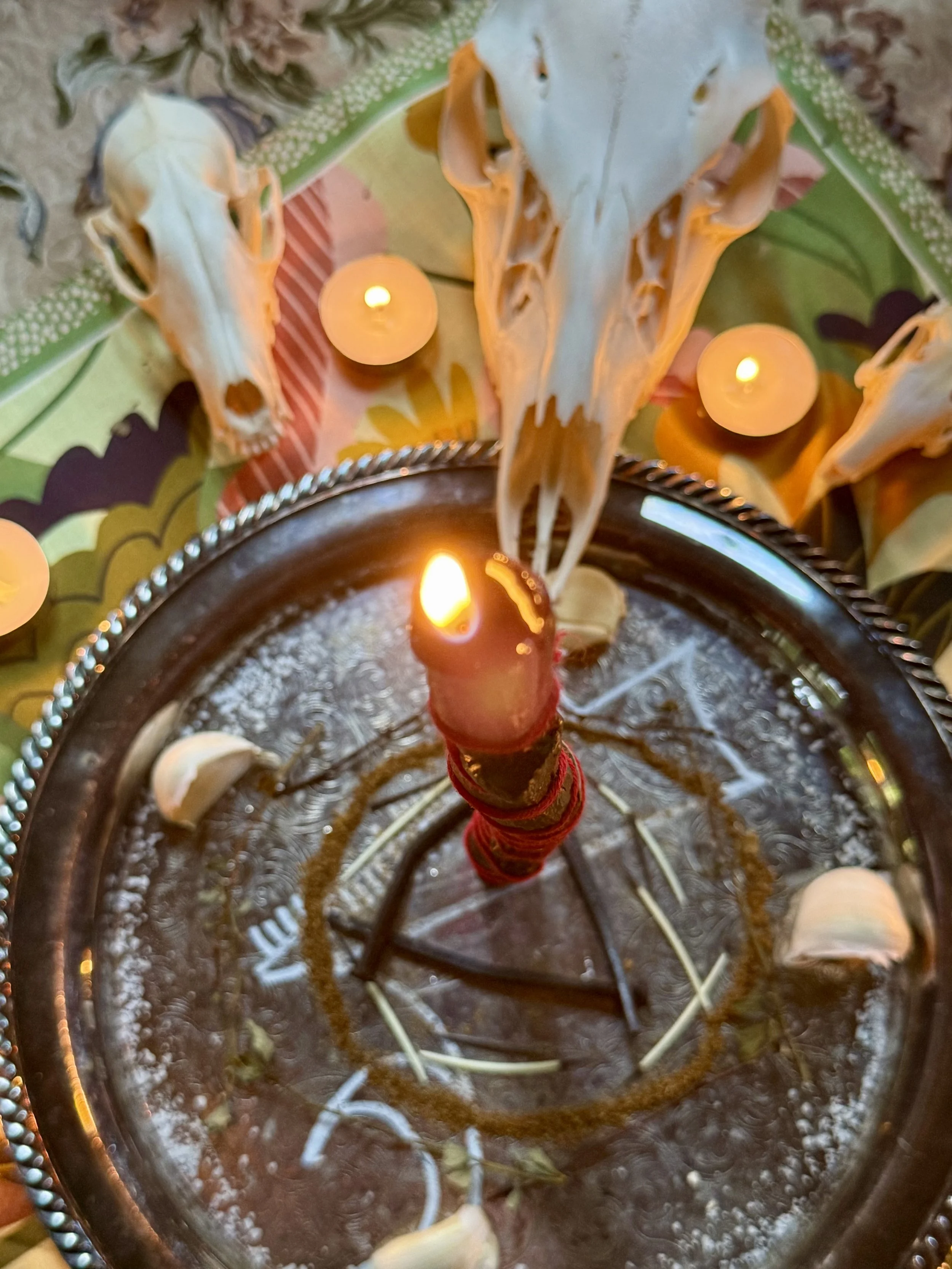
The barberry bush is endemic here, and I have been waging war with it. It’s dug deep into the soil of my home, and my partner and I have been hacking away at it for months. But when I stepped into the grass this past week, looking for a thorned ally - there it was: barbed and quietly murderous. Mo dhraíocht chosanta, my protection magic, mirrors me - incorporative of two places - divided. I have often read that the magic that you need grows just beside you. So when I felt dragged into the mud and knew I needed to clear it, I simply stepped outside. I may not have a blackthorn to partner with nearly, but I listened to the words of the wind whispering through the trees here.
This is an example of how I hold ancestral work - not only with the traditions of my blood, but in allyship with the land I am on. The purpose of my work is to share my unique and personal approach to the blending of my Irish American folk magic, and my northern Appalachian roots.
If I suspected a charm was set against me, I would of course need to ascertain a general understanding of what the charm is, and who is setting it. Now, I am speaking generally here because, when I suspect ill-work, I would not yet know if it was purposeful or not. All of the above would need diagnosis. Folks take many approaches to this, but I do lean on two particular areas to help define this for me: divination and intuition. The latter may be laughable to some, but my intuition has yet to steer me wrong. Can intuition be wrong, or biased? Sure. This is where I follow up with divination - and not just this - I tap my community. If you are in doubt, speak with your peers. More often than not, they can exercise their skills and strengths to help shed light on the matter. I find spirits, saints and deities are other strong relationships to call-in when charm-setting is suspected. A gentle reminder, however, that no one person or spirit should work for free - acts of service should always be reciprocated or paid for.
So once a suspicion is validated by various sources, a cure should be prepared. Cleansings, for me, are the first step of cures. Like many with Irish heritage, I turn to water. Springs, wells, lakes or the sea to wash me clean. If you don’t have access to any of those, I like to prepare a hyssop or nettle bath for uncrossing, the latter of which I was reminded about by my friend Olivia when she and I were in Ireland. The herb can depend on the season, most often it does for me, and I usually turn to nettle in the spring, and hyssop for later periods. Add a dash of holy water for good measure, if you are so inclined. Prayers, naturally, are an important part of the bathing: there are a few interesting ones I have come across and quite enjoy, both as Gaeilge agus as Béarla [in Irish and in English]:
From Prayers of the Gael:
Gabhamaoid le n-a gcoimirce
Agus diúltaimíd d’ á n-imirce
A gcúl linn agus a n-aghaidh uainn
I n-ainm an Athar agus an Mhic agus
an Spioraid Naoimh. Amen.
We refuse their protection,
We accept their departure:
Let their backs be to us and their faces from us.
In the name of the Father, the Son, and the Holy Spirit. Amen.
Keep in mind it’s not an exact translation, and I’m sure you’re questioning the use of a prayer specifically against Evil spirits for the Evil Eye. For me, this has been effective all the same, if I personify the Eye and keep the charm-setter in my own mind’s eye. An eye on an eye. Because it technically comes from inside someone, doesn’t it? I remember in Irish class my teacher drew a clear distinction in describing one’s eyes [an súil], and how we “have” them. When we are discussing eye color as Gaeilge, she said, we would use “agam” - ‘at me’ or ‘in my possession’ - as opposed to hair color, for which we would use “orm” meaning “on me”. So, hair would be “on you,” but you "possess" an eye - even though both technically originate from within your body. Therefore, in this case isn’t the Eye held within the overlooker…possessing them? Or possessed by them? Mary Murray Delancey said, “with the coming of Christianity, stories of demons and spirits of evil who engaged in constant struggles with the powers of goodness and truth were quite common in Ireland”. And an evil-doer or act is just as damaging as an evil spirit. While I understand the differences here, I want to cover all bases.
A charm recorded by Lady Wilde was noted to have come from St. Mary, given to St. Bridget, who wrote it down and hid it in her hair: “If a fairy, or a man, or a woman hath overlooked thee, there are three greater in heaven who will cast all evil from thee into the great and terrible sea. Pray to them, and to the seven angels of God, and they will watch over thee.” Presumably “the three” are Father, Son and Holy Ghost, but this may present some issue if a practitioner is not comfortable even approaching Christian folk faith in their practice. If the one praying was a practicing Pagan, I would say they could pray to the three faces of the Mórrígan, or Na Mórrígna: Badb, Macha, and the Morrígu [or the Mórrígan]. Or perhaps, three particular saints. Another recording of Lady Wilde’s featured a bolder and more direct approach: “For the Evil Eye, a piece cut from the garment of the evil-eye’d, burned to tinder and ground to powder, must be given to the person [often in a drink] under the baneful spell, while [their] forehead is anointed with spittle thrice.” This, Lady Wilde says, is “spitting three times in the face of the evil-eyed to break the spell”.
Probably my favorite cures I have come across recently are immortalized in The Schools’ Collection of Folklore, established by the Irish government in the 1930s. It is quite easy to cross reference in the Schools’ Collection, and in searching for particular topics one may see a number of similar entries - showing the true breadth of widely held traditions across the island. To cure the Evil Eye, many entries note that one must write the alphabet down on a piece of paper and burn it under the nose of the afflicted [this was most often recorded in reference to cows - but I find it works just fine for us people too]. *Please do not endanger animals to recreate this. This was often done when folk didn’t know who set the Eye against them - “so that the initials of the evil-doer cannot escape”. If you have confirmed the name of the charm-setter, you could write their name down on a piece of paper and burn it under your nose as well. Of course, do so responsibly, and don’t endanger your health. I like to add herbs to the burn that are of meaning to me here - like juniper, yarrow, nettle, or hyssop. The last herb is very biblically aligned, as recorded in Psalms 51:7: “Purge me in hyssop, and I shall be clean; wash me, and I shall be whiter than snow,” and is a staple in my garden here in northern Appalachia. The herbs to use are really up to personal preference - again if you are not inclined to include Christian themes within your work, you may prefer to consider the work of Déin Chécht, the great healing god of the Tuatha Dé, or that of his daughter, Airmed.
I also like the recommendation by some schoolchildren to wear a red rag to prevent the Evil Eye - not only do we see the color red aligned with both protection and the Otherworld in Irish folklore, but we see red as a protective and counter-curse color across many cultures. Returning now, to a direct approach: some folk are recorded seeking out those who had set the Eye against them to ask them to reverse it - and in many cases they would be asked to bless the afflicted. It may have seemed easier in the time of these stories to determine those possessed of the Eye, so rarely did one get a visitor in rural regions. But I do love a direct approach. In those days, if a neighbor or a stranger were to enter the home and ‘overlook’ the butter without a blessing or an offer to help, they likely would have a difficult time with the host of the home. And don’t even consider throwing out a complement without a “God bless it” - a phrase cited many times in The School’s Collection [noted as “Bail ó Dhia air” as Gaeilge]. Interestingly, I also found a passage as Gaeilge from An Gort Mór National School in Rosmuc, County Galway: “Mara gcuire tú bail Ó Dhia ar duine déanfa tú drochshúil dhó,” indicating, I think, that if God’s blessing was not put on a person [from the speaker], that the speaker may cast the Eye upon them - seemingly widely held piseoga.
If the afflicted or a family member of the afflicted did decide to invite one possessed of the Eye back onto their property to try and cure it, they may not directly confront them but secretly cut a piece of cloth from their clothing to burn under the nose of the afflicted - as Lady Wilde recorded, mentioned earlier. Again, widely held piseoga - I like to think of this as “burning the Eye out”.
Whether you’re overlooked by jealous people, or folk trying to siphon your energy or steal from you, or even by one possessed of the Eye unknowingly, it’s important to protect yourself and deal with problems of this nature swiftly. I don’t think one should live their life always looking over their shoulder, but having an understanding that not all eyes that look upon you will hold you kindly, is important. Our ancestors knew it, inherently, and it’s something that magical practitioners need to keep in mind as we move through path and community. And certainly, being self-aware is paramount. If you find you’re sitting with jealousy and could be possessed of the Eye, walk with intention - work toward the root of it, to remove it, and understand the impacts that raw emotion and thoughtless action or words could have on another person.
It’s an exercise in transparency, I think, to remember our humanity. Researching this topic has reminded me to look inward at my own thoughts, feelings and behaviors - to be mindful of how I may affect others. In times of trouble I always think of mo sheanmháthair, my grandmother, and the benevolence she would often prescribe. A proud Catholic woman of Irish heritage, but as strongly as she defended the Faith, she defended her family with a harder shield. She reminded me, always, to stick up for myself, and to defend those that couldn’t defend themselves. My grandmother spoke truth to power, i gcónaí, but she never let disrespect simmer on the same burner. Understanding, I think, was one of the greatest tools in her life kit.
No, I don’t think one possessed of the Eye always knows it, but I think it’s important to hone the skills of recognition and of preparation to deal with these situations as they arise - and they inevitably will. A seasoned practitioner will have likely had to remove an droch-shúil at some point in their time practicing, and as we have learned, the common folk were well aware of its existence and the damage it could cause. If I’ve learned anything from reading old Irish writings, the Eye was something that equalized all of us - as I said in the beginning: none of us are totally safe from it. Some seanfhocail, old words, I quite enjoy for this: “níl bua gan dua,” the English being, “there is no victory without hardship” - and more colloquially, no pain, no gain. The road ahead will always be filled with rocks and mud, I think, but with a brand new pair of brogues to rattle over the bogs, we’ll make it through.
Stay well, and stay watching.
Slán go foill, see you soon.
Shaun, the Wee Moss Witch
www.weemosswitch.com
Works Referenced
National Folklore Collection, The School Collection, dúchas.ie
Irish American Folklore in New England, E. Moore Quinn
Celtic Magic, Brigid Ehrmantraut
Ireland’s Hidden Medicine, Rosarie Kingston
Irish Customs and Rituals, Marion McGarry
Legends, Charms and Superstitions of Ireland, Lady Wilde
Of Irish Ways, Mary Murray Delaney
Prayers of the Gael, Te Deum Press
11 seanfhocail (proverbs) that unlock timeless wisdom through the Irish language, Ireland.ie