
Lá Lúnasa
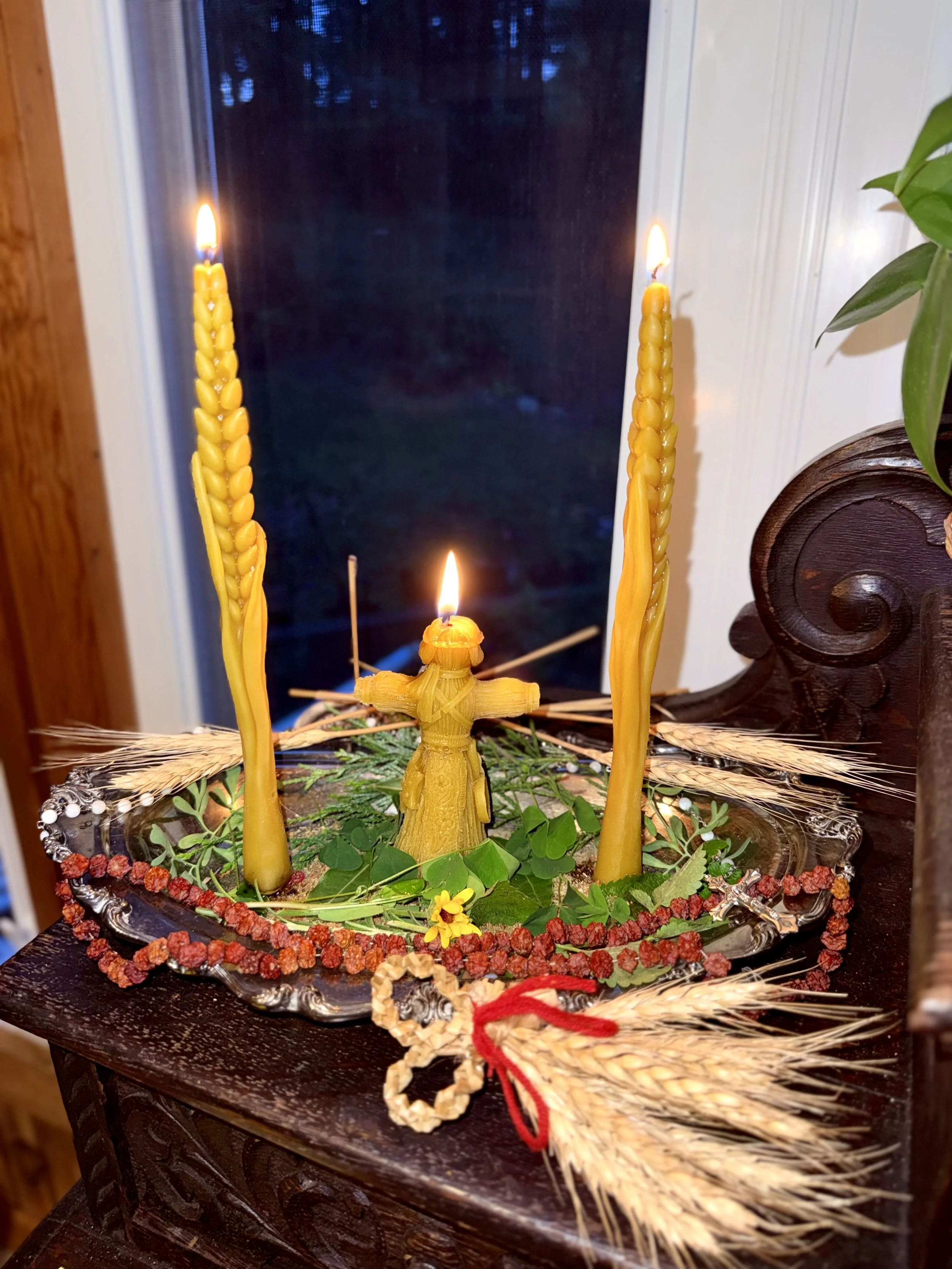
My wee Lúnasa altar in our new home.
Preparing for the End
It is Lúnasa again, the first harvest, and I am thinking about funerals. Odd, I know. But there is one particular funeral on my mind this feast day - it is that of Tailtiu’s. The path is here, just beyond the tall grain - let’s walk it together.
In the early lore preserved in monastic manuscripts, Tailtiu was an otherworldly woman or a goddess, a princess and the adopted mother of Lugh Lámhfhada (“of the long hand”). She was born to a Spanish king and a queen of the Fir Bolg people - a tribe in Ireland that predated the Celts and were believed to be of the Otherworld. She married into the Tuatha Dé, the tribe of gods, and became matriarch to Lugh. In the stories, Lugh is a being of incredible power, a “folk memory of a comet tearing through the sky” in the tales - but not a “sun god,” as some tertiary sources would have us believe ¹.
Tailtiu’s death is described in The Book of Invasions of Ireland (Lebor Gabála Érenn), a premier text of early Irish lore and literature. Exhausted from her tireless work to clear lands for farming, Tailtiu made the ultimate sacrifice - it has even been suggested she came from Spain to introduce the agricultural arts to Ireland thousands of years ago, aligning her with our Neolithic ancestors. As she lay dying, she petitioned her son Lugh to clear the woods around the little rivers so that local folk could participate in funerary games to honor her. Lugh cleared the old forests where Tailtiu fell, and that place became known as Tailtin (“Teltown”) near the River Blackwater, where Lugh Nosad is held - the funeral games of Lugh. Lúnasa, or Lughnasa, is celebrated in this space from the beginning of August spanning two weeks each year - where horse and chariot racing, boxing, wrestling and other feats are performed.
But this was not the only bit of ancient folklore we get on this day - oh, yes! Dear reader, there is more. Garland Sunday - the closest Sunday to Lúnasa - is known in the Irish tongue as Domhnach Chrom Dubh, Black Sunday, and is aligned with a great myth of battle. The myth tells of the tyrant god Crom Dubh, challenged by our youthful hero - Lugh - who fought the old god to take back the harvest - a symbol of the triumph of the people over hunger. Lugh is the people’s god: talented, strong and victorious - an echo of the early farmers that came to Ireland to find fertile land. But this battle repeats each year - as the harvest does. It is the cyclical fight for life.
August Day, the literal translation of Lá Lúnasa, is held as the first harvest celebration across Ireland - and in our modern times is celebrated on the first of August. Other spellings and translations of the festival like Lughnasa or Lughnasadh I’ve read to mean the “assembly of Lugh,” but I don’t have a handy citation for this - if one exists - and the last is a potentially medieval Irish spelling that has been heavily appropriated by Wiccans and Neopagans since Gerald Gardner created “The Wheel of the Year” in the 1950s. Further research required.
Anyway, in 20th Century Ireland, not long after my family left those shores, Lúnasa was held as the period between August and November, where folk would begin the harvest period, celebrate Michaelmas, and climb the holy mountains. After Hungry July, a time when food stores are low, folk looked forward to the first harvests - as we do here in Appalachia. There are so many beautiful practices we share with our ancestors at this time - as even here, in Northeastern Turtle Island, most of the vegetables in my garden are just starting to ripen. Many Irish American folk in the Northeast head “down the shore” at this time, and there is even a link to this in the folk memory of our ancestors - in some parts of Ireland folk would travel up the coast to “consume three mouthfuls of seawater” as a mild laxative ². More on our shared love of the water later on.
But let’s return to the beginning - with the ending. Tailtiu’s death, her funerary celebrations, hold deep meaning during this period for me. We are entering the most important time of the growing season - the ripening - and as a gardener with Appalachian frontier farming ancestors, I have been taught to pay special attention to the cycles of life at this moment. We are rapidly approaching the close of the season, and in Irish and Irish diasporic traditions funerals are an important time of honoring that shift and liminality of the closeness and discomfort of change. We have a very comfortable-uncomfortable relationship with death, we the children of Éirinn. We don’t quite revel in death - we sit with it. Literally.
It is an auspicious tradition one must sit up with the corpse for three nights - perhaps to wait out a false death, as was a major concern prior to modern advancements in medical practice, to protect the deceased from roaming spirits, or even from those that wished to remove it from the home and the yoke of the family. And yes, this was all done in the home - the preparation, the wake - all of it up to the Mass. Mirrors covered, widows ajar - rich is the folklore surrounding the death of the Irish. We in the diaspora hold firm to this - there are prayers to be whispered, songs to be sung. The Wake precedes the service, prayer cards are printed and items and amulets are left with the deceased to protect them.
The point I am getting at here is that funerals are highly important events in our calendars and to align one with a harvest festival is the ultimate reaping. The presence of grief in the heat and amidst the blooms is nearly overlooked in the rain and the lush. But Lúnasa, despite its funerary imagery, is not the end - it’s the preparation for it.
Sometimes, we look around at the abundant blooms and vines hanging heavy with fruit in this summer season and still feel hollow - and that speaks to me as an ancestral echo. A warning of winter hunger, perhaps, or a chill in the bone under the sun as our remembering of the cold. All things come to an end, but life is cyclical and seasonal in every aspect. There may be endings, but they are always followed by beginnings. We must always be prepared for the grief of the goodbye, but even that is nearly impossible to conceptualize through our modern lens. In life today, the world is at our fingertips - but our ancestors on any land did not have instant access to life’s most treasured comforts: high-speed internet, refrigeration, etc. They had to part with what they loved, even seasonally - and this made those temporary comforts even that much sweeter. The taste of ripened fruit picked directly from the tree or a cherry-red tomato that nearly jumps into your hands - we hold these memories tight in the dead of winter for warmth, knowing however, they will come again.
Nothing truly ends, does it? It only changes. We only change - as we should. So let’s duck back into the field to explore a few more themes - it’s this wee path here, just to your left, a chara.
For our ancestors in Ireland over the last few centuries, the first meal of the harvest was an event that was believed to stave off hunger for the rest of the year - so important it was. Like Bealtaine, Lúnasa was a faire time, where communities would come back together from their field or shepherding work for merriment, to celebrate each other, and for specific observances of commemorative events. Farmers moved their livestock through water as a charm of protection for the coming year - even people and horses swam to preserve them from evil and there are even recordings of butter being tossed into lakes as an offering for this. Hungry July would end with feasts of the first potato harvests and bilberry treats - frachóg - an ancient food and dye.
Lúnasa was a harvest season, not merely a day. From Garland Sunday to Gleaning Sunday (the final gathering of crops) right up until Michaelmas on the 29th of September, folk are harvesting - but after this day, the Puca - or folk devil - spits on the Earth’s fruits. It is most often blackberries he spits on, in the lore, after being defeated by St. Michael - so this festival effectively closes the harvest season for some produce. A folktale that is likely to warn harvesters of the fruits going bitter after this date. Michaelmas is often celebrated with apples, pies and berry harvests as a last hurrah, I suppose.
It was all hands on deck during harvest time across the country, especially in smaller and rural communities - echoing our approach in diasporic Appalachia. Farmers would reward their workers and families with a ‘harvest home’ feast - also known as a ‘reaping dance’ or ‘the head’ and would turn an unused space of a barn or dwelling into a party area. The last sheaf of the harvest was auspiciously hung above the table by the woman of the house - this last sheaf being known as the cailleach - the witch - who the workers had ceremoniously ‘slayed’ to conquer the harvest. This sheaf was often twisted into a plaited straw ornament or harvest knot, which vary in shape and design across the country. It was used as a protection amulet as well, rumoured to protect the home until next Lúnasa. Popular dishes at these events may have been large apple dumplings, bacon, beef or cabbage, and in some areas of the country, ‘stampy’ bread was on the table - a traditional potato bread, or a meal of newly dug potatoes.
So, maybe Lúnasa is about things like reunification, remediation, and reciprocity - the holy trinity of R’s. Coming back to the whole - to the collective - and choosing to not only exchange valued goods and tools to survive with your neighbors, but to also work together to reverse problems and prevent them from becoming systemic. Returning to the home unit after a year of hard work to look around at all the wealth and beauty of the land and people on all sides of you - and that it is not for the taking, but for the sharing. That it is so beautiful because it is so temporary, because all things end just to begin anew again. Change comes in with the harvest wind and the last sheaf, and we must shake its hand and pull up a stool to our table. Lá Lúnasa shona duit! Happy Lúnasa to you!
Slán go foill, see you soon.
Shaun, the Wee Moss Witch
Works Cited/Referenced
1 Magan, Listen to the Land Speak
2 Quinn, Irish American Folklore in New England
3 McGarry, Irish Customs and Rituals
4 O’Dowd, Straw, Hay & Rushes in Irish Folk Tradition