
Grab a Stout Blackthorn, to Banish Ghosts and Goblins
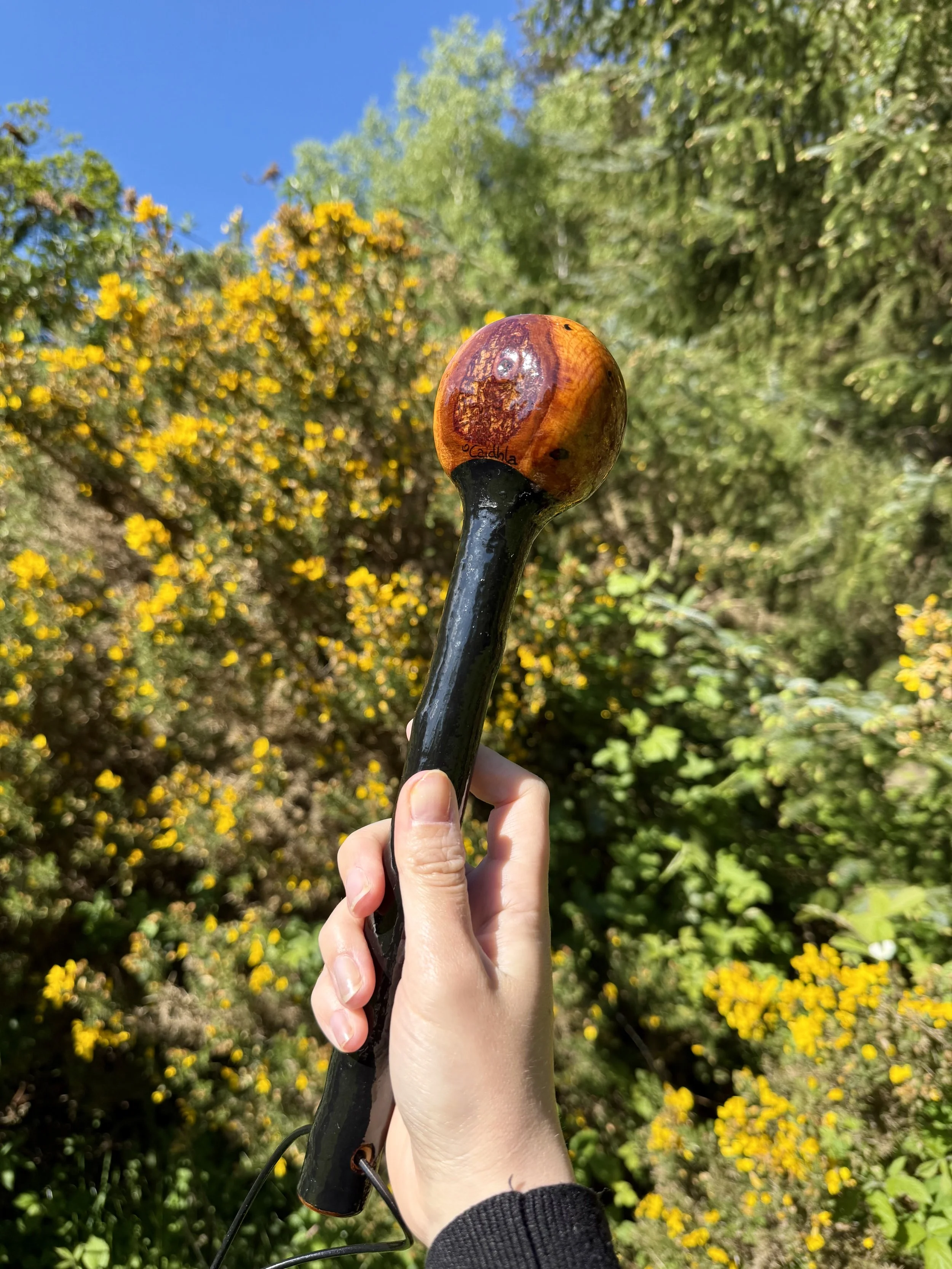
A traditional Irish cudgel (club), lead-weighted and carved from a Blackthorn branch
Made by the Olde Shillelagh Stickmakers in County Wicklow
Selected Plants of Protection in the Irish Hedgerow, and in Appalachia
To protect oneself is a rite of all living creatures - it is our base instinct, to ward off mortality and harm. In Ireland, and later, as emigrants to America, folk took as many opportunities as afforded to protect livestock, crops, stores, the young and the old from any threat across the vast landscape beyond the hedgerow. Whether a curse thrown by a neighbor, a witch stealing milk straight from the pail, or a chance encounter with the unruly Othercrowd, our Irish and emigrant ancestors employed many allies in the hedgerow and across the wayside to keep themselves safe and sound. And those plants - as if following emigration lines - have cropped up in America too, where we now lay our roots.
In the 19th century, D. K. Gavan penned the song “The Rocky Road to Dublin,” detailing a rural Connemara man’s trip across the island to the city of the Pale. The song is rife with themes of folk life and lore, including the addition of an ancient stick - as the shillelagh, the famous fighting and walking stick, is so often referred to: “grab a stout blackthorn, to banish ghosts and goblins”. This line underscores a turning point in the song - the dangers of the journey - and the tools the folk employed with both a physically defensive plant, and the tree’s treasured lore.
Here, in this piece, I want to discuss the plants that endure with our ancestral lines - relatives and cousins in their own right - that have grown up alongside the displaced. We have all re-naturalized together, in a way. A smattering, a curated and carefully picked group of plants that I find myself often reaching for when it comes to protection work. As an Irish American folk witch, I feel a kinship with these plant spirits that I have met across the Irish countryside, and here in the Appalachia, where I lay my bare feet in the soil.
*A warning that while we will discuss the recorded holistic uses for plants in folk medicine, I am not a medical professional nor an herbalist, and I do not encourage the unsupervised use of any of the plants named below. Always consult with a qualified professional before working with plants.
But first, what is a hedgerow, and what part does it play in Irish folk life?
The “hedgerow” is the term used in Ireland to describe the strip of land that divides farming pastures, and those pastures from the motorway or, in earlier times, the wilderness. It is an entirely natural fence for livestock, but has also been referred to as “nature’s highway,” kept by careful trimming over centuries of ancestral maintenance. An incidental “wildlife corridor" serving to shelter birds, insects and wildlife species from one end of the land to the other, and an almost mythically cultivated preserve for indigenous trees and flora to thrive. The Irish hedgerow serves many purposes, and one of the many is safety, protection for its inhabitants. Not only for physical shielding, but the hedgerow also allows for the flourishing of native foods like nuts and berries that sustain non-migratory animal species.¹ As a once heavily wooded country, Ireland’s hedgerows echo the spirit of the island’s past, a presence still so important to the cultural identity of the nation through what feels like a magnetic force that connects people and land.
Currently, the hedgerows are disappearing. Traditional techniques of maintenance, like “Hedgelaying” - the careful curation of layering plants to create a thick fencing to keep herds within, and ensuring the vitality of the hedge - is time-consuming and expensive. Commercial farming and consolidation, and a surge in affordable housing and transportation needs, are all contributing to the endangerment and loss of habitat in these wild spaces, and with it, the folk stories and histories hedgerows hold are at risk².
Naturally, in a place of such abundant life, there is also an abundance of folklore to be found. Here in Appalachia, we don’t really have “hedgerows” as they appear in Ireland, being a heavily wooded region of Pennsylvania and beyond. However, we do have hedgeplaces - per se. I see these as roadside thickets, magical growths of green, vines or disturbed soil where hardy plants crop up and expand wildly beyond the asphalt. Of course, our hedgeplaces are edged by trees, large and small, growing up over the motorways in a beautiful curve - much like the trees that book-end Irish roads. An echo of home.
The very first plant I want to discuss here is one I pass by almost every time I leave the house - the Elder tree. An incredibly mystical being in its own right. I will organize the plant allies within this text with their English name (as Béarla), their Latin name, and their Irish name (as Gaeilge).
The Elder, Sambucus nigra (Trom)
The Elder tree is a titan of the wayspaces - a plant that can exist on the margins and command the respect of its neighbors. An old Irish saying, as Gaeilge (in Irish), illustrates a cautionary approach to Elder in the lore: “Trí comartha láthraig mallachtan: tromm, tradna, nenaid” - three tokens of a cursed site: elder, a corncrake, nettles” - as quoted by Tony Locke. Perhaps this is due to Elder’s rule of disrupted and overgrown soil, and certainly of its association with the Fair Folk. As quoted by Coitir, Lubhdan’s poetry (Silva Gadelica I) cautions against burning Elder wood, to avoid enraging the Good People: “Elder with its tough bark, truly wounds the most/burn it into charcoal, steed of the fairy host”³. I pass Elder often on my journeys, here in Appalachia and often in Ireland - it is a bursting of beautiful cream flora amongst the green. As you can imagine, it stands starkly against the hedgerow with this attribute, but is a powerful companion to it. Elder is said to be the host of a witch’s spirit, and a bad tempered spirit at that, as it is often called crostáil as Gaeilge, or “mischief”. Children or animals hit with an elder stick wouldn’t grow, and using Elder wood to build items like cradles for newborns was discouraged. Elder wood was, as legend has it, the alleged wood of Christ’s cross, and a tree believed to have refused to shelter him. Elder is also mentioned in several traditional Irish tales of revenge. A tricky one, Elder.
However, stories of Elder as a great protector pervade, despite its sordid history. To have an Elder growing near the house is very lucky in Ireland, traditionally near the back door, standing against the posterior of the home to keep evil forces at bay. Elder’s leaves ward off flies and other insects, and if near a kitchen this would have been particularly useful in keeping disease-carrying pests away from the family’s sustenance (likely cooling at the window). This may account for some stories of the Elder’s narcotic scent, and warnings to never fall asleep under the tree. Locke tells us that branches of the Elder would be hung near doorways of homes and barns, and even on horses to keep flies at bay - and the evil they bring. Interestingly, Elder has further connections to food lore - it was believed to protect dairy from turning, and was planted near bake houses to ward off the Devil, and the plant even served as a cooling shade for cakes.
Here in Appalachia and the Americas, Elder is equally reverent. It is a valued medicinal plant, used by Indigenous folk in washes for blood poisoning, for colds, fevers, headaches, measles, and stomach upset, as reported by Corinne Boyer. The bark was used to soothe swelling of sores and for bruises, and it was even used as a decoction for pain⁴. The folk of my region in Appalachia make jams, jellies and syrups from the berries, and I have even seen fritters made of the flowers and the dried heads used for toppers on cakes. You know it’s cold and flu season, and further, you know we are inching closer to the darkness of winter, when these items start cropping up on farm stands. Our Irish ancestors would use this plant in folk medicine as well, for anything from burns, to colds, to dyes.
I love using Elder in both spells and in homemade brews. The stories of the Elder hosting the spirit of the cailleach, or witch, rings true for me. Elder evokes an energy of an eerie power, not quite intimidating, but confidently firm. I have found that working with Elder has boosted my own confidence to sit heavily in my power and my voice. I enjoy using the florets or dried flower heads around candles in protection work. It brings a beautiful, light color to the working, and aesthetically surrounding the candle with these flowers reflects the sun in an affecting way. It is also a wonderful addition to spiritual washes and especially floor washes for protection - I like the idea of employing the dried flowers of Elder in a floor wash both before and after difficult or rowdy guests - paying careful attention to the back entry way of the home. The same goes for window and door washes. The dried flowers would also work wonderfully in an incense blend for a purifying cleanse after a particularly difficult spell - one that asks much of you.
I partner with Elderberry for many things. I always have a homemade syrup on hand - The Green Witch has several videos on this process and recipe recommendations. Local honey and cinnamon are hearty companions for this brew, and the berries need to be carefully cooked in order to be edible - so please do thorough research if you plan on making this syrup at home. I also quite enjoy elderberries as a dye or ink - especially for writing in one’s book of draíocht (magic), or for yarn art. The Elder tree is quite a welcoming ally, I’d encourage you to approach them in a careful and warm way, always with an offering of water or song. I find they love songs.
The Blackthorn, Prunus spinosa (Draighean)
The dark mother of the woods, the wishing thorn, the Blackthorn. A tree of ill omen, and the most dangerous tree in the lore of the Celtic-speaking peoples - it is named straif in Ogham - whence the English word “strife” comes. It is a plant associated with winter, the dark moon, warfare and bloodshed. One of the most practical and popular uses of the Blackthorn in Irish folk life was the wood of the tree fashioned into a weapon, called a “cudgel” - and bata or shillelagh in the Irish - a club formed from the knob at the shrub’s root or branch curves. Blackthorn wood is strong, durable and polishes with a beautiful natural reddish color - ideal for both fighting and walking sticks⁵. In the times of our ancestors, Irish stick fighting was a well respected (and feared) sport that would employ cudgels, and Irish stick fighters were well known for their hearty brawls at celebrations, fares, and even at funerals.
But even without the cutting and polishing, the Blackthorn is pretty treacherous in its natural form. The tree grows upon its branches long, sharp thorns or “spines,” believed to be tools employed by the Devil to seal pacts, and in some stories, used by witches as a tool to send their victims into eternal sleep. It fueled the pyre lights, once denounced by the Church, of accused witches and heretics.
Blackthorn represents the cycle of life and death, blooming when snow still covers the landscape at the dawn of spring - even before the plant puts out leaves - lovely pearls of white against the dark wood. The ashes are a rich fertilizer for crop soil. It is a great addition to the hedge wall, near impenetrable, and makes an excellent shielding ally against harm.
Naturalized in the Eastern U.S., Blackthorn puts out dark purple fruits or “sloes,” and in the Victorian era, sloe gin was very popular - believed to be drunk for kidney health in the British Isles, but the sloes were also used as remedies for coughs and fevers. Folk would also make wine and jam with Blackthorn fruit around old Christmas. The leaves had multiple uses - taken for indigestion, hayfever, dried and used as a substitute for tea or tobacco, and the bark was used as an external wash. Here in the Northeast, the Blackthorn has landed on some invasive species lists in certain states due to its aggressive underground spreading, but it has been spotted in parts of northern New Jersey, New York and Connecticut⁶. Its establishment here borders on introductory status, but it seems to prefer crisper northern weather.
Corinne Boyer shares some practical uses from her own witch’s apothecary - incorporating the spikes into hanging charms above doors and windows is my favorite, either balled up in yarn with other herbal allies or across a line - like one would hang nails. I quite like the idea of the Blackthorn spike being used in place of an iron nail (a favored tool of mine), if one wanted to approach a spell strictly with plant ingredients. Boyer also recommends carrying them in partnership with other herbal allies against ill wishes, or as powdered incense.
I am new to a relationship with Blackthorn, having just met the plant spirit during my time in the town of Shillelagh ~ buying my first cudgel! I stopped in at the Olde Shillelagh Stick Makers during my Bealtaine visit to Ireland, and found the perfect cudgel - a lead-weighted, hand-held club to hang at my front door (my Irish American version of a baseball bat for home defense). Immediately, I was taken with the artistry of the Stick Makers: the crafters of carefully carved, shaped, and stained masterpieces that have such a story behind them - months of work for just one piece. As Irish as the green land herself - I am grateful to own a piece hand-made in County Wicklow.
While this is absolutely an item I will enchant and incorporate into spellwork, I will certainly be on the lookout for Blackthorn spikes to use in jar workings, in stitch witchery and beyond.
The Rowan, Sorbus aucuparia (Caorthann)
Rowan is a well known, and centuries old, protector against malefic magic and draíocht, or witchcraft, in Ireland. In Irish folklore, the color red is associated with the Otherworld, the Fair Folk, the goddess An Mórrígan, and magic - of course, and it also resembles blood, and physical vitality. So, the color red was used as a ward against all of those things, and as a supporter of vitality - it’s folk name “quicken” or quickening, life-giving powers, echoes this⁷.
This sort of reminds me a bit of the Doctrine of Signatures - a centuries old approach to plant medicine that dictates that a plant’s physical appearance, like color, shape, or home space, indicate what it can be used for medicinally - but this time for folklore. The red of the Rowan against the red of the Otherworld, or for the red of the blood. Get it? An old rhyme says it all, as quoted by Locke: “Rowan tree and red thread/make the witches tine {lose} their speed”⁸. Another producer of beautiful white flowers, like its neighbors the Hawthorne and Blackthorn, Rowan was associated with the Othercrowd in this way as well. Its Irish name, Caorthann, speaks to the striking color of Rowan’s fruit - “blazing flame”.
As we have discovered, Elder guards the back of the house, and Rowan guards the front - but Rowan could also be brought inside to protect the dwelling from fire. Hung about the dog’s neck to increase its speed, hung on the cow’s tail to ward off witches, and thrown in the dairy pail to keep the hag from stealing it - Rowan was used both by our ancestors and in living traditions today in a variety of ways.
Rowan was a particularly favored ally during Bealtaine season (May), as the month of May is believed to be a liminal and dangerous time for livestock, agricultural investments, and the home space. During this time, the home was decorated with Rowan branches and flowers - across doorways, hung from rafters, in windowsills, as was the cattle - yes, the cattle were decorated too. If you’re imagining a cow walking around with a Rowan stick tied to its tail, you’re on the right track. In pre-Christian times, Rowan twigs were used for divining, the berries were used for ceremonial dyes, and the bark was used to make amulets. While this tree was associated with the Fair Folk, it was also used to protect against them - like many of the related trees we have (and will) examine together. Rowan, in some stories, featured as a key ingredient in the rescue of folk from faeries, and the wood - when fashioned into a walking stick, or even just a twig placed in the pocket - was used as a shielding tool against their mischief.
Rowan is certainly the witching tree, so striking in appearance - grey bark, fern-like leaves of deep green, and “dragon-claw” berries, as Boyer writes, it is a member of the Rose family - no doubt, a head-turner. Coming upon a fruiting Rowan in the wild is like standing at the precipice of the Otherworld, an entryway marked in red - food of the gods⁹. It is also known as “Mountain Ash” with no relation to the Ash tree.
The Rowan is also a treasured medicine as well, in both Indigenous Irish and American traditions. Valued for fevers, purging, and clearing the blood in the old country, and here on Turtle Island, Indigenous healers used Sorbus sitchensis, a native American variety of Rowan, for dandruff, rheumatism (chronic pain in the joints, muscles and tissues), concerns of the kidney and stomach, and for ear aches. So multi-faceted.
My personal practices surrounding Rowan are many - it is my fiercest ally, next to Juniper. Since the time when I first met Rowan, I wear them on me every day as an amulet of daily protection (consentually, of course). The Rowan I partner with for this comes from ancestral land, and was collected from fallen parts of the tree and ethically foraged, so no harm was done to it. I employ the berries in many magical preparations, and honestly, just having a small jar of them nearby makes me feel shielded from negative influences. A circlet of Rowan normally surrounds my workings as a circle of protection - and has since become my very treasured branding.
Rowan is a spirit that speaks very plainly. Whenever I encounter them, they are quite honest, encouraging and challenging. They’re always pushing me right up against my comfort zone, and remind me to face hard truths, in a way that doesn’t feel forced. Rowan stands at my front - blazing hands, ready to strike if needed. Rowan reminds me of my grandmother - and is, of course, a plant ancestor - a woman outspoken, a spitfire with a heart of gold. But she was extremely straightforward, often in an intimidating way, in her baby-faced-killer honesty. She was courageous, our Di, one of the strongest people I have ever known. I hear her laughter in the rustling of Rowan branches, when the sun comes out.
Stinging Nettle, Urtica dioica (Neanntóg)
Nettle is a medicinal powerhouse, and the folklore surrounding it corresponds with this. Its root name from Latin, according to Corinne Boyer, holds the meaning of “burning itch” - while the common name comes from the Old English “netel,” derived from needle. The Old Irish name means “fire”. April is the month to pick Nettle, when the early leaves are tender and most nutrient-dense. A dose of Nettle in April would prevent disease for the rest of the year - so believed the Irish, but the rhyme also exists, “Nettles in May keeps all disease away”. To pick Nettle at a graveyard while reciting the names of those sick could dispel their fever, and serving the boiled water to a patient with fluid-retention was believed to cure them. Many rural folk would include Nettle in soup - as it contained more iron and Vitamin C than spinach, and boiling the plant is the only way to deactivate its stinging hairs. During An Gorta Mór - the Great Hunger of 1845 in Ireland - Nettle was a well sought-after bit of sustenance in the countryside, where all other food was scarce. Nettle contains anti-histamines, which is helpful to folk with allergies, and also boosts serotonin. It has been reputed for fertility and joint pain, but must be taken with caution by more sensitive groups.
According to Allen and Hatfield, no plant has been featured as extensively in the folk medicine of the British Isles as Nettle has. Over one hundred records note the use of Nettle as a spring tonic to cleanse the blood. About sixty exist for drinking Nettle tea to help alleviate measles rash, over forty for joint-pain complaints - some dating back to Roman times - and over twenty for cold, coughs and lung issues. It has been recorded for a wide variety of other uses, used both internally and externally.
An Irish folk story recalls the search for the Eucharist that had fallen from the mouth of a woman into a crack in a church floor. Years later, the woman had fallen ill, and within the crack where the host had settled, Nettle grew up to protect it. A priest found the host in the crack and returned it to the woman, who was cured. This indicates that Nettle may have been believed to be a holy plant. Nettle was also significant in ancient Celtic medicine and folklore. It was used to treat wounds, to stop bleeding or hemorrhaging from battle, and lovingly named “devil’s claw,” pointing the direction to the homes of the Fair Folk. According to the ancient Celts, if you were stung by Nettle you were safe from witches or enchantments. Nettle makes great food for certain livestock birds, and if left to decompose in water, makes a great fertilizer.¹¹
Nettle is a staple here in Appalachia, for the witch, forager, and homesteader. According to Leah Middleton, it’s known as “devil’s beard” here (and I’ve also heard “devil’s nettle”), and is used in a variety of crafts. Popular in salads, sautéed dishes, and teas for inflammation, the Scots-Irish ancestors of the mountain folk would create fiber for fabric from Nettle. It is also used as a dye, and will leave a light red stain as its mark.
One popular bit of folklore, as recalled by Middleton from the Scottish ancestors of this land, was the fall of the Devil and its relation to Nettle. In some versions, he falls from heaven into a blackberry bush, in others, a Nettle patch. I’m not sure which would hurt worse, but I’m leaning toward Nettle - having been stung too often. According to Boyer, Nettle was used by the Iroquois, along with dried snake blood, in “witching medicine”. From the Kawaiisu tribe, children would prepare themselves to perform magic by walking through nettles - believed to toughen their skin, or potentially, help them “procure dreams”. According to folklore, Nettle can be used for cursing, counter-cursing and protection work.
I love Nettle for just this. Not only do I work Nettle into culinary dishes, but I love incorporating the plant or water into workings for curse-breaking, using the leaves in boundary work (as a literal boundary around the spell), and I am also a big fan of using Nettle in standard protection workings or bags I carry on my person. Even in standing wards around the home, Nettle is useful. It is a fantastic ally all year round, but there is some merit to utilizing this plant in early spring, when it is at its height of power. We all have our seasons. I do feel a shift when I work with Nettle throughout the year, so be mindful that the plant may have a preference. This aligns with the active listening we need to do when we partner with spirits - and plants, like Nettle, can be very vocal. So next time you’re boiling Nettle for a soup or for a sautéed dish, save the water to work with later. Or next time you’re in the woods, listen for their call - even if it's just above a whisper.
Foxglove, Digitalis purpurea (Lus Mór)
Foxglove, or “Folk’s Glove” - the gloves of the Fairy Folk - is an extremely poisonous plant, and has been positioned as the “most dangerous plant in Ireland,” not only due to its toxic nature, but also its heavy association with the Good People. Most commonly pink or white within the hedgerow, Foxglove protects against evil when kept in the garden, but the plant is unlucky to bring inside. Folktales tell of malicious faeries that gave the Foxglove blooms to the Fox to muffle the sound of their feet when they hunted. Foxglove was a remedy for a child or adult suffering from “faerie stroke,” for which the juice of twelve leaves daily was prescribed¹².
The leaves could also be placed under the child’s bed, or placed in the cradles of babies to break enchantments. Patients could be rubbed all over their skin with the leaves as a charm against witchcraft, a practice that was exceedingly dangerous. The fód seachrán, or faerie grass, when stepped on caused the desire to travel at no end, the cure for which was believed to be Foxglove. While we see many themes of Foxglove being used to counteract faerie enchantments, the plant will always nod its head to one of the faerie gentry when they pass by.
From Boyer, some Irish folk stories tell of Foxglove’s colors symbolizing Otherworldly beauty, and that their colors are reflected in the cheeks of the beings that inhabit the Other. To remove evil, or protect one from it, an amulet was made from Foxglove, a neolithic arrowhead (or an “elf stone”), bogwater, salt and money - balled up with six other herbs, thought to be of the highest power in Ireland - ground ivy, vervain, eyebright, groundsel, elder and hawthorn¹³.
Digitalis was introduced into general medicine practices in the late 16th century. In folk medicine, it is used to strengthen the heart, and this knowledge is originally believed to have come from the herbal lore of a rural wise woman. Specifically, the official medical discovery is attributed to Dr. William Withering, who spent ten years experimenting on the folk to be touted as a founding father of clinical pharmacology. In rural regions, Foxglove was prescribed for fevers, sore throats and colds due to its purgative attributes, but can be a reckless medicine to approach for these issues. Across the country, there were differing opinions about the plant: some believed it a poison and kept their distance, and others lauded its use in everything, and took it daily for long life. According to Allen and Hatfield, folk practitioners generally avoided prescribing it for internal use, from the amount of recorded deaths it caused, and it was also a failed remedy for tuberculosis.
Foxglove is mainly a cultivated garden species here in my corner of Appalachia, thriving in rainy and wet periods of our summers. It does well in both carefully curated gardens and disturbed soil, so we can certainly say this wild plant “cleans up well”. As a plant of the poison path, it is a great ally for left-handed and curse work. I find that when employed in this way, Foxglove doesn’t have much of an explosive effect on the target of the spell - so it is great for use when you want to lay low and for your spell to be untraceable. One could also lean on Foxglove’s almost hallucinogenic reputation - not literally, but metaphorically. It can be used to blur the lines of consciousness, so the target would likely never guess which direction they are being hit from, and the effect would almost leave them in a stupor. Leave them confused, but certainly down for the count. *A reminder to use caution and always do thorough research, every part of this plant is poisonous.
Honeysuckle, Lonicera periclymenum (Féithleann)
Honeysuckle was referred to as Irish vine or woodbine, and even “fairy trumpets” in earlier times, indicating its prominent presence in the folklore of the land. It grows like a thick, viney wall across the hedgerow, and if grown across the entrance to the home, it was believed to prevent witches from entering, or bring good luck. In the garden, this plant would protect against evil, and in the kitchen, a drink made of it would cure the Evil Eye¹⁴. In Ireland, honeysuckle banished bad spirits, and was believed to be a money-drawing (or wedding-drawing) plant if brought into the home. Its binding nature represented, well, binding, everlasting love, and therefore was also associated with fertility. The blooms were used to perfume cosmetics, and the wood of the wine was used for walking sticks.
Honeysuckle was used medicinally, the leaves and flowers being used for headaches, colds, fevers and aches and pains of the joints due to the high content of salicylic acid found in them. They have been found to be anti-inflammatory, and effective against some bacteria¹⁵. Under the Brehon Law in ancient Ireland, certain plants were protected due to their importance to the community - and the Honeysuckle was protected under the “lower divisions of wood”. However, the berries are highly toxic. In many areas of Ireland, it was used to cure thrush, a fungal infection of the mouth and other regions of the body. Briefly, according to Allen and Hatfield, it was introduced for tuberculosis and whooping cough.
Here in northern Appalachia, Honeysuckle is a staple of summer. Although we often are overrun by the invasive Lonicera japonica in built-up areas and in the woods - I have found this plant growing wild around old oak trees on my grandparents’ homestead. However, its invasive status never stopped us from standing at chain-link fences or along the stone walls of the woods, plucking the delicate flower heads to suck the nectar out of as children. We could clear away full feet of the plant if left long enough at it. I distinctly remember my now-husband introducing me to his favorite honeysuckle spot in our early twenties. *Again, always exercise caution when consuming plants!
Honeysuckle is an incredible ally for banishing negativity. Juliet Diaz, in Plant Witchery, discusses this plant as a protector of peace, “she protects what she loves”. Diaz goes on to recommend this plant as a protector of families and children, which feels like an absolutely perfect fit. This plant may look beautiful and harmless, but its strong arms could completely choke out its host. Honeysuckle vines are apt for binding and forming barriers, or even for roping things together. I prefer to think of this plant as a living wall - an echo of the hedgerow itself. Honeysuckle stands tall, with their face to the sun, but will readily open their arms to shield the worthy.
Overall, your relationship with plants, and how they work together with you magically, is up to your making. Review the folklore to discover how a plant has been used historically, regionally, or find traditional manuscripts or compendiums of Materia medica (pharmacy knowledge) to discern how a plant was employed medicinally. *Always consult with a qualified professional before employing a plant for use internally or externally. Ask questions, like - was a plant or tree associated with the (often invisible) Fair Folk? Maybe, then, it can help you reveal hidden truths. But also, we need to learn to look beyond what is recorded, toward our own intuition. What does a plant speak to you upon its greeting? Is a plant physically spiky or thorny? Then perhaps it can be used as a partner in defense. Can you even approach this plant, or touch it? Is it seated just out of reach? Maybe, then, it is an excellent ally for removal, or boundary work. If you can physically access it, close your eyes and interact with it - if it is safe for skin contact. What energy does it evoke? What does it say?
Maybe, to your great disappointment - nothing. Maybe the plant will not speak for you. Maybe that is a sign that your aspirations of partnership with this plant are not for this current moment. It is important to remember - and I am speaking as an animist here - that humans and plants are part of one collective whole. We are relations, equals, and therefore, the plant will signal to you its consent and interest in working with you. Some cues will be more obvious than others. It is important that we listen.
And especially, that we listen to local voices. What land do you stand on - are you hearing and open to the lessons that native voices seek to teach us? These local spirits are ancestors of this land - perhaps not our blood ancestors - but they deserve no less respect and attention. How can you work together ethically, and still honor and respect the sacred knowledge of your line? How can you work with invasive plants ethically, or help support the restoration of natives to your area?
I will certainly share my tried and true approaches here, and tricks I have learned along the way, but it is imperative that you work this into your individual and communal approach. Make it your own, share it with others, and leave what doesn’t fit. I’m grateful that you’ve joined me here, in this walk through my garden at the edge of the woods. A fitting beginning.
Slán go foill, see you soon.
Shaun, the Wee Moss Witch
Works Cited/Referenced
1-2, 5, 7-8, 11, 12, 14 Locke, Tales of the Irish Hedgerows
3 Ireland’s Trees, Niall Mac Coitir
4 Boyer, Under the Witching Tree
6 iNaturalist Map {linked}
9-10 Boyer, Under the Witching Tree
13 Boyer, Under the Dragon Root
15 Allen and Hatfield, Medicinal Plants in Folk Tradition, An Ethnobotany of Britain & Ireland
Juliet Diaz, Plant Witchery