
Fómhar: Autumn Alignment
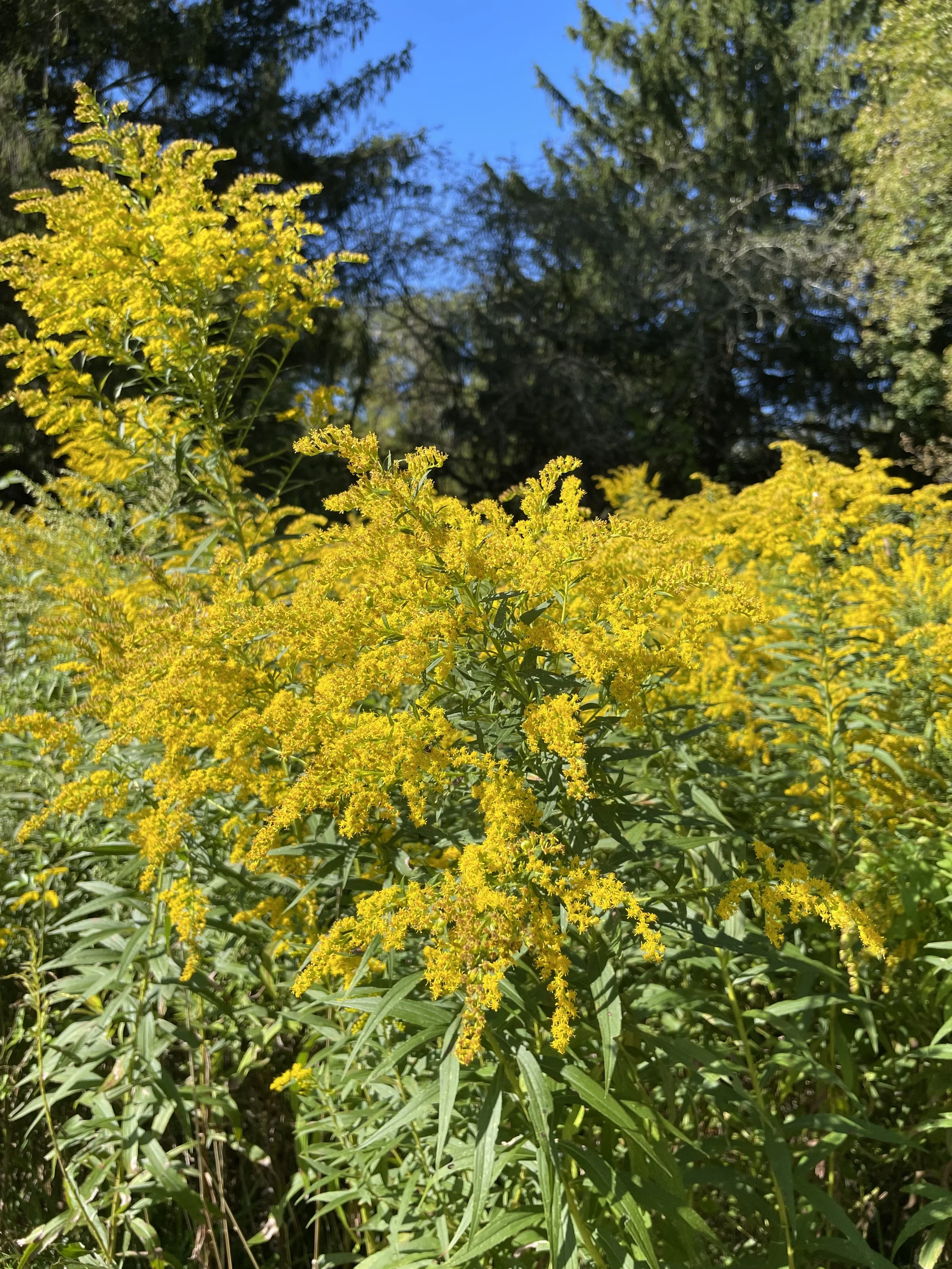
Goldenrod of northern Appalachia
Autumn arrives on the backs of geese, gliding down their tail feathers as they ride the skies - chasing warm winds south. Autumn builds slowly here in northern Appalachia - the cricket song somehow louder within the yellowing grass and alongside browning blooms than at the height of summer. Like our ancestors sa bhaile, at home in Ireland, neighboring farmers in these hills and hollers are working hard against the encroaching dark to reap the health of the fields, and build their winter stores. We are seeing the slowing of corn on market stands, but an abundance of tomatoes (finally), and the squashes come to ripen.
As Cónocht an Fhómhair {pron. co-knoct ann o-wir in the Connemara dialect}, the Autumn Equinox draws near, the season is visibly changing with noticeable signs in our Appalachian Mountains - and echoing Irish hills. The air is crisper and cooling, which does change harvesting patterns throughout Meán Fómhair, September, or “the middle of the harvest”. The importance of this period is evidenced in folklore recorded in The School’s Collection of the NFC: “in harvest the people are very busy gathering in the crops for the winter. They bring in hay, oats and turf; when they have all done they have a dance and have music and great fun.” Winter is coming, and it’s dreary, this record recounts. Autumn is observed in Ireland from Lúnasa to Samhain day, mirroring weather patterns much like our beloved Northern Appalachia - a “sultry” start, the trees transforming to yellows and oranges, then to rougher and cooler weather. In the Irish folk calendar, Michaelmas Day approaches on the 29th of September, an important date to venerate St. Michael, a “spiritual defender against the dark of the night” (McGarry) in the folk faith. An excellent spirit to call-in during this season. But how did our ancient, Pagan ancestors observe this period? I love examining the through-lines of the ancient and pre-modern folk culture - it is one of my favorite things about exploring my Irish heritage. My people have been so deeply spiritual since their beginning, and this is reflected for me right down through to my grandmother, my cousins, my aunts - and in the traditions we all hold still.
There is evidence that Cónocht an Fhómhair was significant spiritually and ceremonially to our ancestors, but we don’t fully understand why. Were the Stone Age peoples celebrating solar holidays? Some believe so. At the ancient funerary site of Loughcrew in County Meath, there is a specific Cairn (tomb or stony mound), Cairn T, where the light of the Autumn sun on the Equinox illuminates the passage tomb - the first rays stretching all the way to the back of the mound and lighting up beautiful spiral carvings on the wall, presumed to be solar or celestial symbols. The site is believed to be about five thousand years old, like Newgrange, which aligns with the solstices, dating back to the Neolithic period. I had the pleasure of standing in one of these cairns at Newgrange for around thirty beautiful and silent minutes, within inches of the carvings there as our guides showed us the range of illumination. I will be uploading a video detailing this entire experience on my YouTube channel soon! Loughcrew itself is also known as Sliabh na Caillaigh, the Hill of the Cailleach or ‘witch’, likely named for stories of the ancient Irish goddess throwing stones from her apron to form the mounds (IPS). It was proposed that the first passage tomb at Knowth aligned with the rising sun during the equinoxes by archaeologist George Eogan in the ‘80s, but this has recently been challenged, based on a new survey of the complex (Prendergast).
Last year at this time, I was focusing on release and change - and how to negotiate my growth within my current realities. This year, after so much drastic change, I am focusing on alignment. Just as the sun alights the symbols at the back of Cairn T, I am letting my path illuminate before me. What feels right, based on the evidence I uncover? Based on my instincts? I can’t achieve the goals I set out for myself unless I am actively working to align them with the realities of my life. I can harvest all I want - but what will I do with the fruit and the corn? That’s what I want to focus on as I move into this next cycle - how I can use these tools to my advantage, to root myself better into the soil of my own tilling.
Given the influences of our heritage, how can we celebrate Cónocht an Fhómhair as Irish Diasporists? How can we align the lore and cultural inheritance of our people with our modern folk work? While we have looked well far back, at the patterns that our New Stone Age forebears left behind for us to find, we can also cast our gaze to pre-modern cultural movements in Ireland, around the time our ancestors were escaping the forced starvation of their occupiers. Both groups of Irish - ancient and pre-modern - were agriculturally based, we know this, in opposition to the indigenous Irish groups of the Mesolithic period, who were engaging in hunting, gathering and foraging to survive - while farming was brought in with the Indo-European immigrants (Cassidy et al.). Up until my ancestors farmed their lands in Eastern Mayo and were forced to leave, our people have been agrarian. And of course, farming is still of major impact in Ireland.
Michaelmas and the Autumn Equinox both are harvest days in Ireland. “Summer is Summer, until Michaelmas,” Marion McGarry says, immortalizing an old phrase in ink. She describes this cultural holiday as an equally important time to settle contracts or to conduct legal transactions, and for elections, in addition to the completion of the harvest. St. Michael defeats the púca at Michaelmas, and the devil then spits on the berries after this date, bringing in the frost. Maize harvesting is traditionally finished around the end of September in Ireland, and by Oíche Shamhna, November Eve or Hallowe’en, ground and tree fruit crops are gathered in. Spring-hatched Geese are released to feed on the stubble left behind in the shorn fields in September, becoming fat enough to be eaten by Michaelmas - “on Michaelmas night by right divine, the goose is chosen to be the swine”. McGarry also highlights the link of the Goose Harvest to an old Irish story of the death of a King’s son, who choked on a goose bone, and was then resurrected by St. Patrick. Goose has been eaten in Ireland on Michaelmas to honor this miracle. Old customs abound on Michaelmas - pilgrimages to holy wells, blessings of the saint, weather divination, fairs, and even effigies of Micheál burned in some regions where parades were held.
Michaelmas, to me, is a time to work on the protection of prosperity in one’s life. Recently, I rewatched Gangs of New York as an adult, only ever having seen it as a child, at the instance of my Irish American father. Growing up, my father was adamant about how important it was for me to consume Irish media - famous films of both the homeland and of the Diaspora were paramount to my education as a proud cailín of Irish heritage. Scorsese is well known for his fascination with the Irish Diaspora, and as a very young child I watched Gangs of New York, opening credits to ending. During my recent re-watch, I couldn’t believe how much folk magic and Diasporic culture was included, and as much as I could barely look past Leonardo Dicaprio’s atrocious accent, I found a great example in the treatment of St. Michael. Dicaprio’s character is the son of an Irish immigrant - his father a devout Catholic and leader of the Irish American gang, “the Dead Rabbits,” nicknamed “Priest” Vallon - both characters having immigrated to American shores just following An Gorta Mór. The opening scene is one of the preparations preceding a gang war between the Irish immigrant Dead Rabbits and a gang of WASP New Yorkers led by the brutal, conservative, anti-immigrant Billy the Butcher - played by Daniel Day Lewis. Vallon and his son are shown with a St. Michael metal, praying to the saint for success in battle. The full prayer is a common one recited in the Irish Catholic faith, “St. Michael the Archangel, defend us in battle. Be our protection against the wickedness and snares of the devil” (Gill Books). I recognize this was a…bit of a long story for the payoff of a short prayer, but the point I am trying to make here is that St. Michael is an important character in Irish Diasporic culture as well, and is certainly called upon to protect what we want to preserve. And you should also watch Gangs of New York as an adult. *I need to note: this film dramatizes the New York City draft riots of the 1860s, where violence and murder were carried out against Black Americans by Irish Americans, which is extremely harrowing and difficult to watch. It is important to recognize that it did happen, and is a vile stain on our history - but it should be remembered. Gangs of New York is about discrimination, and includes examples of all kinds on American shores.
The harvest season is coming to a close and Summer with it, and we may be looking at a long winter ahead. It is a thin time, and as the seasons shift, the migrations or changes of animals may become more obvious to us. I opened this piece with a visual of the bird migrations we often see as a clear sign of seasonal changes here in Appalachia, but I also see the squirrels hurrying to collect walnuts that fall from the trees, the deer’s coat becoming darker, and the fox’s becoming thicker. In Ireland, the harvest hare has been mentioned in some stories - spotting a hare is deemed to be a bad omen or one of witchcraft (IPS), and indeed this is highlighted in some School Collection stories: with tales of hares stealing tools to cut corn - and the corn itself! Hares represented the liminal, most active at dawn and dusk, and were believed to be shape-shifted witches or the sí - faerie folk - in disguise. I remember when I first saw a hare run across a sheep field on a foggy morning - it’s unnaturally long legs carrying it across the grass so fast that it was gone before I could blink. Right around the time of Bealtaine too - spotting a hare during these thin times often carried the belief that they were a traveller from the Otherworld, hurrying home.
So, with the thinning of the season, we light our red candles against the gathering dark. I recall stories of country folk decorating their doorways and windows with yellow flowers around Bealtaine to ward against the sí, who hate the color yellow. Well, during an Fómhar Buí, the golden Autumn, we could decorate our thresholds with yellow fallen leaves, perhaps. In northern Appalachia, at this time, September is a well known month of sunflowers and goldenrod - I imagine a wreath or bouquet near an entryway of these would serve as a stunning, and locally supportive ward. And of course, what self-respecting Appalachian doesn’t have Autumn mums decorating their porch? A yellow crop of these wee darlings at the door or stoop would be sure protection against the Othercrowd.
Cónocht an Fhómhair is an abundant period of alignment - both for our cousins across the water, and for the Diaspora on local shores. The fruits of our labor are ripening - the tomatoes are red, the corn is sweet, and the blackberries are bursting. We take stock of what we have gained and lost, and how we will mindfully move into this next cycle. But I think we also need to remember what is right for us to release, and for what sake. Wading through the thousands of social posts during the Autumn Equinox that tell us to “release what doesn’t serve us,” is largely exhausting, and contributes to an overwhelming pressure to shed our skin or our lukewarm connections at every impasse. Yes, we humans cycle with nature - constantly in change, in flux - but are we truly being mindful of what we leave behind? Or are we simply validating isolationist tactics to punish those we don’t agree with, and cut them out of our lives? This is why I’m focused so hard on that word alignment - what am I aligning myself with now, and what future goals should I align with my path? Does it really make sense for me? Are my choices meaningful? Well thought out?
We have a tendency to live too quickly these days - Pumpkin Spice lattés return as soon as July ends, Hallowe’en decor hitting the shelves in 90 degree heat. It speaks to cycles, yes, but the heavy implications of consumerism isn’t mindful - it’s destructive. What are we aligning with, and why? When we look back at our distant or recent ancestors, what traditions did they hold that supported their lives, their survival? How did they hold the harvest mindfully, knowing full well that the food they picked and stored at this period may mean life or death when the frosts came? As the sun slowly pours into the passage of Cairn T at Loughcrew this Equinox, as it has for the last five thousand years, what small magics, traditions and cures that preserved by the Irish folk do we know still hold meaning to its people? Many and most. We should look to Loughcrew as a marker of longevity, along with the Irish way of life. How can we replace consumerism with longevity? What is the personal, regional and environmental impact?
I hope you have a beautiful Cónocht an Fhómhair, and you can carve out slowness and meaning in your busy days ahead - as we gather, preserve, and survive together.
Beannachtaí,
Shaun, the Wee Moss Witch
Works Referenced
National Folklore Collection, The School Collection, dúchas.ie
“Autumn Equinox in Irish Paganism,” (IPS) Irish Pagan School
“Alignment of the Western and Eastern Passage Tombs at Knowth, Tomb 1,” Frank Prendergast, Technological University Dublin, ARCHAEOASTRONOMY RESEARCH Collection
“A dynastic elite in monumental Neolithic society,” Caddisy et al., Nature journal
Irish Customs and Rituals, Marion McGarry
The Pocket Book of Irish Prayers and Blessings