
Honoring Grief & The Irish Keen
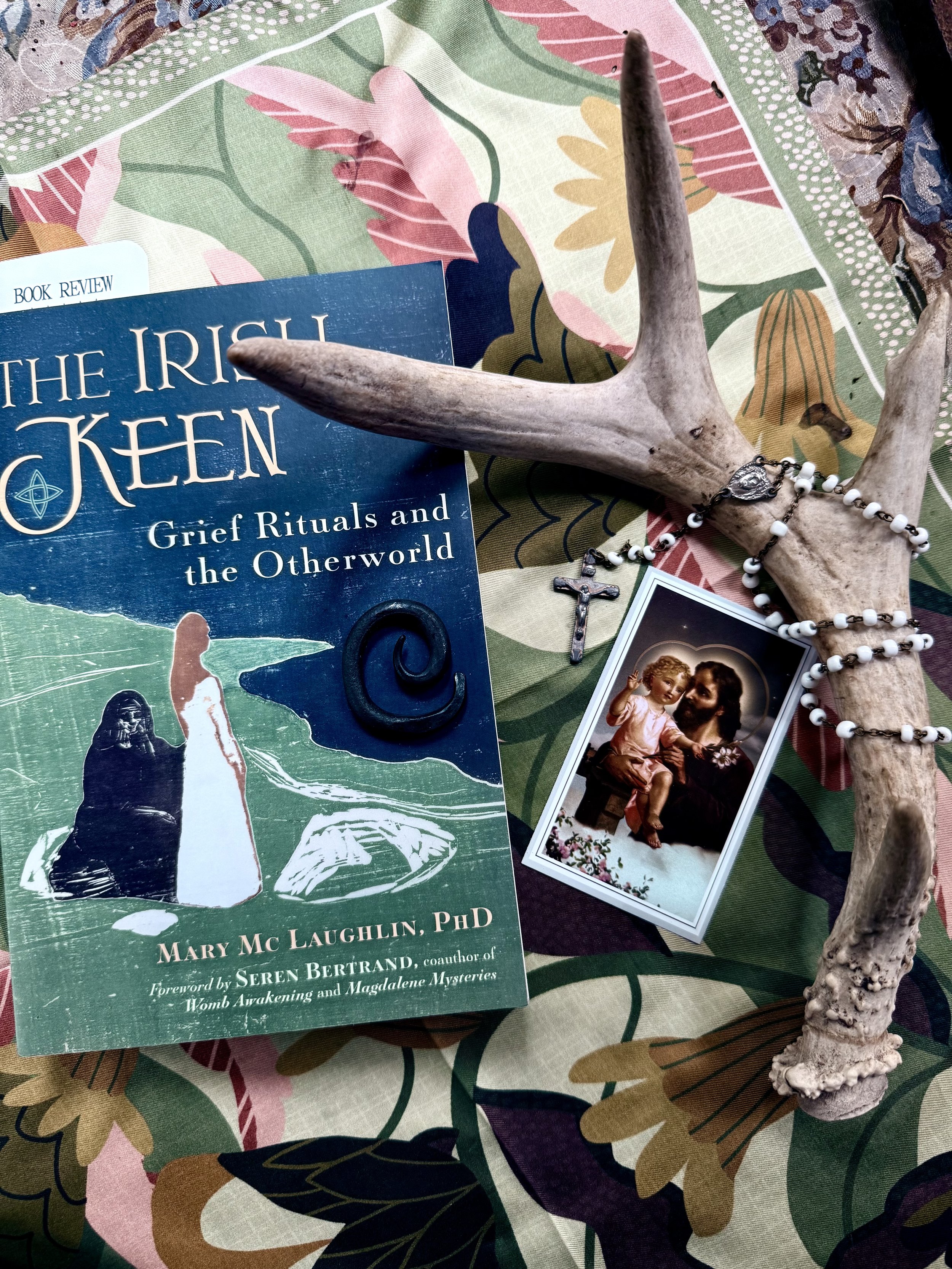
This past week I have begun Dr. Mary Mc Laughlin’s new book, The Irish Keen: Grief Rituals and the Otherworld, and it feels like a warm welcome home - abhaile. Funny thing to say about a book written on grief and death, eh? Not when we consider how deeply rooted funerary rites and rituals are within the Irish cultural consciousness. And as we move closer to Samhain - the end of the harvest - not when I consider my own deliberate avoidance of the Keen.
But what is the “Keen”? Caoineadh (Kween-a) or Caoin (kween) - “an expression of sadness or regret,” or literally, a “cry” [Foclóir]. Dr. Mc Laughlin defines it an ancient funerary lament, that includes not only vocal songs, cries and calls, but also incorporates specific ritual, and is believed to move a spirit out of its corporal body - to its final home. “An improvised Irish lament, [literally] sung over a dead body within the context of a wake and funeral, partly in the Irish language, and partly in vocables” (Mc Laughlin). Therefore, throughout our ancient ancestry and into our more modern memories, the Keen has served as a cathartic grieving tool to comfort the bereaved through community service. With our collective grief of recent news - of how rapists are punished (or not) and victims silenced, this is a moment to better understand the lamenting scream.
Dr. Mc Laughlin, in her opening preface, adapts an account of a rural Irish wake from 1841, attended by a witness raised outside of the keening community in a city. Within, we share this witness’ apprehension at the immersive ritual guided by the Mná Chaointe (Min-aw Kweencha), the Keening Women, as they both physically and vocally attempt to move a woman’s spirit from her cold body. This is a ritual often led by women, but there have been references to male Keeners, demonstrating that this ancestral song is for us all to hear (Mc Laughlin). The Keen appears an essential part of the Wake, as are the roles the Mná Chaointe - sovereign stewards of the dead, and a comfort to the living. They stand in a role akin to a. Earth-side psychopomp - a guide to the afterlife - ferrying not only the dead, but also the living, through a ceremony a millennia old. Indeed, we have a citation for this - payment for keening was mentioned as early as 890 CE in Cormac’s Glossary, according to Mc Laughlin.
While I am loving Dr. Mc Laughlin’s book so far, I always check subjects of my research against the National Folklore Collection (NFC), and if you are a regular reader of the Irish American Folk Magic Blog, you will know how highly I esteem this resource. Stories of Keeners are often preserved in the folklore of the wake and funeral. The accounts I have read on Keening provide either similar or new information, underscoring how Keening was a widely held practice, but could change depending on the Keener, or locale. One account carefully describes the Keeners’ particular placement around a body: “one at the head of the bed and the other at the foot,” and not only would they cry and wail, but they would also catalog stories and recollections of the deceased so that mourners could come away with a heartfelt final image. The Keen ritual is multi-generational, Dr. Mc Laughlin discusses this, and a ‘Wake Games’ account on the NFC also makes specific mention of this concept: “We will keen for his childers and childer on till the last of their breed is extinct," demonstrating that the tradition lives alongside the folk. Another NFC story recalls the Mná Chaointe as legitimate roles specific women played in communities as their jobs. The women described, a pair of O’Brien sisters, were known by this recorder to meet funeral processions on the road and join them, traveling far distances to Keen for folk with whom they were not even acquainted or related. *I do want to note: given this evidence that being a Keener appears to be a legitimate role within the Irish community and within Irish death rituals, the suggestion exists that the role is learned, it may involve a tradition passed, and should be approached with respect and curiosity, not with extraction. Such a treasured and time-honored tradition demands reverence.
The different accounts I have both read and heard on Keening paint a colorful and multi-dimensional picture of a tradition that lives within our folk memory. The accounts were all very clear that there is a stark divide between the Wake period (of up to three nights, to observe the Keen for the deceased and mourn with the community,) and the Christian funeral (that only the family would attend with the parish priest). Although a characteristic difference exists, the two practices - both integrated and side by side - demonstrate the duality of faith within the Irish practice - pagan undertones to Catholic ritualism.
The first time I heard the term “dual faith” from Frankie Castanea, “Chaotic Witch Aunt,” I knew it was a living phrase I wanted to incorporate into my approach and understanding of Irish Diasporic spiritual practice - and Keening, with its ancient roots and survival into our pre-modern times, is a wonderful example. “Dual Faith” feels like a familiar lens I observe contemporary Ireland through - the landscape, customs, and observances are informed by ancient stories and traditions, integrated into the Folk Catholic values of the modern day. Keening was very nearly run to extinction by the Catholic Church - admonished by priests as “too Pagan” of a practice for good Christian folk, and that partition was literally visible up until the pre-modern period when the Keening ended at the gates of the church. Another bi-product of colonization.
Another aspect of funerary rites involving the Keen that is plainly stated: the Mná Chaointe, Keening women, are separate to the entity of the Bean Sidhe (woman of the fairy mounds), the mythical Banshee. In Dr. Mc Laughlin’s account she is described as a fairy woman, who warns of imminent death with her piercing wail. She is known to follow some families, even across the Atlantic, to Irish America and likely beyond, tied by blood to specific Irish lines. Another psychopomp, in my opinion, one who begins the act of death stewardship, and hands it off to the Keening Women to complete it - in some way, they are partners. Dr. Gillian Kenny, in her talk on Irish Witchcraft & Folklore, described this spirit as a death messenger as well, who provides a public service to the community by readying them for death - Kenny also notes that her cry, or ‘gol’ was likened to that of a fox’s night scream. I think of my own connection to the Fox, an Sionnach, and the magical ties I bind to its scream, and the workings that follow. It is an indicator for me as much as it was an indicator to my folk.
Like the Banshee - or ‘angel of separation’ as she was known on these shores - who followed the folk on the coffin boats to America, references to Keening tailed us too. E. Moore Quinn notes that some conflation may have occurred between the two, as some Irish Americans believed that ‘a dog barking at odd hours’ could have been “the Keen” of the Banshee. An Irish American informant of Quinn’s recalls her trip to an Irish wake in the old country, where the Mná Chaointe crooned “a high, wordless singsong” before they individually transitioned to specific Irish words that the informant only understood because her mother translated them. The Keening Women, having both solo and ensemble parts in their act, demonstrated the "panegyric nature of their lament” - a beautiful way to describe the song as a sort of eulogy. We do not have many examples of Keening taking place on American soil that I have so far come across, but Quinn highlights a documented record of one George Templeton Strong. In this account, Strong describes the setting of a mass funeral for the Irish American victims of a mining cave-in. Strong paints a visual picture, of men that are “listless and inert enough” and the women, utterly opposite, who were “all together raising a wild, unearthly cry, half shriek, and half song, wailing as a score of daylight Banshees, clapping their hands and gesticulating passionately.” What a powerful image of our passionate heritage, and one that touches me deeply, as a granddaughter of miners who were lost here.
I hope, with the context aforementioned, that I have provided a case for the importance of the Keen, and its survival, through the centuries and down through to the Diaspora. I would also, however, like to share with you my true motive for this pleasant essay: reclaiming my own lost Keen. Earlier, I mentioned my avoidance of the Keen - this has a very particular root. But first, I want to take a moment to comment on a stereotype of our folk, one called the ‘merry Irishman’. This week I also watched (shamelessly, in its entirety over one weekend) the 2026 mini series East of Eden. The character Samual Hamilton is an Irish immigrant in California, likely having been drawn to the West by gold rush rumours. In a conversation with an Asian American man by the name of Lee, regarding the dangers of stereotypes, Hamilton and Lee both discuss white America’s reduction of them into what is expected: a ‘pidgin English speaker’¹ and ‘the merry Irishman’. The two bond over their storied rejection by 19th century American society, and find comfort in each other - outcasts both, but useful outcasts to the bigot white American. In Hamilton’s example, he feels he is expected to always be ‘telling jokes’ or turning phrases, due to what Americans know of the Irish at this time - the notorious ‘gift of the gab’ (ad nauseum). This stereotype could be rooted in lineage: E. Moore Quinn discusses the Irishman as the famed “Gaelic storyteller,” a role of high honor. Telling stories was not only a source of entertainment, according to Quinn, but also a mechanism of hospitality, and most importantly - the orator of these tales preserved the great myths of Ireland: our inheritance.
But, this changed when the Irish came to America. The trauma of starvation, genocide, loss, and death trampled this acclaimed role, this hard-won sovereignty, with the hooves of a thousand police horses. The Irish lost their history in America, their customs, their language - and the storyteller’s warm seat by the fire was reduced and forgotten. Quinn says, “the notion of ‘the hero’ became ludicrous, supplanted by ‘the exile’ and ‘the emigrant’.” I believe this, and so many of the traumas endured within this small period, severely damaged the psyche of the Irish emigrant male, making him more susceptible to assimilation into whiteness - and other vices. With one’s cultural uniquity suppressed and ridiculed, this certainly leaves a wide gap. In my experience, it was filled with stoicism.
I recall George Templeton Strong’s description of the men at the Irish American funeral, “listless and inert enough” - rudderless and languid against the tides of fortune, while the women are presented as strong and industrious. I was raised by an Irish American man, in an Irish American family, and true enough - the men all displayed a rock-hard stoicism in the face of any emotion. Strong enough that it translated to their daughters. My aunts, my cousins - all women who prided themselves on their thick skin and fighting spirit. And here is where I can finally get to the point: my Keen had been snatched, buried, and gagged behind a blank mask of stone.
My grandmother died in March. Not a week is past, and I am sitting in the church pew directly behind my aunts - a printed eulogy clutched and crumpled in my hands. It is a bitter, cold day - a mean day - weather my grandmother did not deserve. The woman who raised seven children and nine grandchildren within our Diasporic culture in coal-mining country, who made me feel deeply connected to something greater. Our Wild Irish Rose, who deserved nothing more than to be waked and keened by all who loved her. I grew up in this church, St. Anthony of Padua's, and the Italian American nuns who haven’t seemed to age a day are sitting behind me. I recall my grandfather’s funeral - his coffin was placed exactly as hers is now - except it all seemed bigger, more towering. I remember my father, unable to finish his eulogy at the podium, having to physically step away as my grandfather lay just below, in his box. I had never seen my father cry - and he didn’t here. His voice croaked, and he immediately jerked backward, away from the mic, mask safely back in place. I blink, returned to this moment - with my grandmother’s body where my grandfather’s had been. There is a small string quartet in the righthand corner of the church - a beautiful touch for a beautiful soul. My aunts ahead of me are falling apart - a concept so wildly foreign to me that I sit uselessly wringing my hands. I have never seen them cry before. I look around to my grandmother’s sons - masks all in place, all above board. But the soft wails of my aunts hit me like a hard wind, weighing me down in water, a rope tied to my limbs and feet. They were Keening, and I couldn’t join them.
We Irish American women were raised tough in this family. Dirt under our fingernails, sharp tongues, with the looming threat of corporal punishment always over our heads. Never was it okay to cry, because if you did, you might get smacked in the head with a tennis racket by your boy cousin. You couldn’t be scared of the ghosts in your granny’s attic, or you’d never live it down. My aunt recently discussed with me her discovery of the word “trauma” - something she had never even heard of, or considered, in relation to her own upbringing. Equally, we were always told that people would look to see us fail, “because you’re Irish²”. People were unfair to us or didn’t trust us “because we were Irish”. Casual mentions of cultural prejudices were normal in my family, perhaps a carry over of the folk memory we held of 19th century anti-Irish sentiments like “No Irish Need Apply”.
My point here is that there wasn’t much room for emotion in our upbringing. However, my grandmother was a woman of both inner strength and sentimentality - but externally tough she was. She devoted her life to championing special education and the needs of disabled children and adults - my first example of a humanitarian. And yet, I couldn’t mourn her. I couldn’t keen her. I couldn’t cry at her funeral, or when I touched her hand a final time. The grief was a hangman’s noose - tightening around my neck like a great snake preparing to devour me. Reaching that emotional pinnacle is a difficult feat, and one I pull back from quite quickly. I not only grieved her death with an anvil of silence, but also, my own emotional absence. That pew was an island, and I was watching my family sail away on a ship through fog and cloud.
Witnessing my aunts keen their mother was an awakening. A connection to place and time of old - a necessary soundtrack to grief, a physical catharsis of it. I could feel the Banshee’s cry ripping through my heart and out of my chest, stopped up in my throat. Grief, itself as a concept, is such a necessary part of acceptance and understanding on our ancestral reconnection journey. Our dear Frankie Castanea says, “grief is a mother birthing transformation," and that, grief truly is. Because grief changes us. It marks us deeply - adjusting how we hold stress, memories, laughter, love, joy and hate. Grief is a proverbial cleanse - it ejects truth from the bone, and a mask of stone is an effort in the face of it. It speaks in cycles, and in this vein, can be generational. I look across the pew, across the generations, connected by tears, and by stone. Within ancestral reconnection, grief is a multi-layered web of both the mourning and the venerating of our dead. We grieve what we don’t understand, and what we do. We grieve both what we lost, and never had: information, connections, homeland, time. Do we cycle with grief, or though it? Maybe both.
I was choking back tears as I read through the first few pages of Dr. Mc Laughlin’s book - her reimagined story of the rural wake. The Mná Chaointe, leading the swaying howl - a spiritual circle connecting all mourners, all people. And I suppose I just had to share with you how it all made me feel. How it has me looking back at tears I can’t cry. The Keen is both a release and an acceptance of self - of who I am by blood, by lineage, by land, and of my own making. I came from these things, but to the last, I define who I become - and how I mourn.
Reconnecting is a difficult, liminal journey, and if you have lost some of yourself over time, I hope you find it here. I hope you find your voice, and your Keen, again.
Beannachtaí,
Shaun, the Wee Moss Witch
Footnotes
¹ In this context, the ‘pidgin English’ Lee chooses to speak in East of Eden to white Americans is a broken English with a Chinese accent, although he was born and raised in California. Lee says that he has taken this approach because it is ‘what [white] Americans expect’ when they see him, providing a visual example of the deeply rooted racism that underlies the story - inspired, of course, by the true racism in 19th century America. It honestly hasn’t seemed to change much here.
² Irish Americans often use “Irish” as a shorthand phrase for “of Irish descent or heritage”. This does not mean Irish Americans believe or claim they are citizens of Ireland (at least, not any with Irish Americans with a brain). It goes without saying that most reconnecting Irish Americans are clear about our diasporic identities.
Post Script
*A note on the text: as always, I never recommend a book I haven’t read fully. This piece is not a recommendation of Dr. Mary Mc Laughlin’s new book, The Irish Keen: Grief Rituals and the Otherworld, but rather an exploration of what it has awakened in me.
I look forward to providing more of my thoughts on it in time.
Works Referenced
The Irish Keen: Grief Rituals and the Otherworld by Dr. Mary Mc Laughlin
National Folklore Collection, duchas.ie
Dr. Gillian Kenny, “Irish Witchcraft & Folklore” (presentation)
Irish American Folklore in New England, E. Moore Quinn